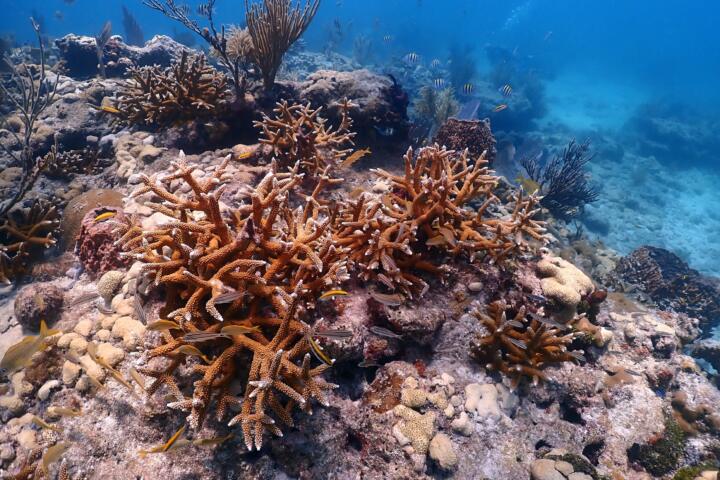
On 12 August 2018, 220 ceramic blocks went into the water off Summer Island in the Maldives. Each began as a mould that had been printed, then cast in clay. The hollow forms were filled with marine concrete and slotted together seven metres down — no barge, no crane, just divers and a set of pieces that only fit one way.
The finished structure covers about a hundred square metres of sandy lagoon floor that had no reef on it at all. Nothing about it was printed coral. What the printer produced was the thing coral needs before any of it can begin: a surface with the right shape, in the right material, at a depth where the water is cool enough to be survived.
That distinction is the whole story of Reef Design Lab, and its founder makes it more bluntly than anyone selling the technology would. “People assume that 3D printing is going to be some magic thing that will save the coral reefs,” Alex Goad told Mongabay in 2018. “Obviously not. This is to be used for small coral nurseries.”
What gets printed, and what doesn’t
Goad is an industrial designer, not a marine biologist. He built the first version of the Modular Artificial Reef Structure — MARS — in 2013 during his honours year at Monash University, and it became the foundation of the Melbourne studio he now runs with a team of designers, architects and fabricators.
The process is one step removed from the name, and the step is the interesting part. The moulds are printed. The blocks are cast ceramic through slip casting, then filled with marine concrete and steel reinforcement for weight. What the printer is actually delivering is geometry: the crevices, ledges and overhangs that give a transplant something to grip and a juvenile coral somewhere to settle, printed once and cast many times.
The material argument is old and unglamorous. Ceramic is inert; cement is alkaline. A reef is calcium carbonate. Goad’s case at Summer Island was that a near-neutral ceramic surface should suit coral better than an alkaline concrete one — in theory — and that the only way to know was to put both in the same water and count what happened.
The real advantage is logistics
The clever part is not the printer. It is that one person can carry the result. MARS II, the current version, weighs 27 kg in air and roughly 15.5 kg underwater. By the studio’s own published count, 1,400 units have been manufactured and assembled into 17 structures across three countries; the tallest, three metres, took 49 units, four divers and two days.
That arithmetic is a design constraint before it is an environmental one. A restoration project with a crane can use any shape it likes. A project with a dinghy, four volunteers and a slope cannot — and the slope is the common case. At Pom Pom Island in Malaysia, the conservation group TRACC is trialling MARS II to rebuild reef that dynamite fishing flattened, terrain where a single poured block would be the wrong object entirely.
A phone call from a marine scientist
In 2015 a researcher at the Sydney Institute of Marine Science found the reef work and asked a different question: if you can add the complexity a bare surface lacks, what about the least complex habitat in any harbour — the seawall?
The answer became Living Seawalls: panels retrofitted to existing vertical concrete, shaped as rockpools, crevices, honeycomb, oyster shell, kelp holdfast. Ten types in all, one of them deliberately flat, because a study without a control is an advertisement.
The results are unusually well documented for a design project, because the scientists kept publishing. Two years after a twelve-metre stretch of seawall in Sydney Harbour was retrofitted in 2018, 115 species had colonised it — comparable to natural rocky shore, with the complex panels supporting up to 264 per cent more species than the flat controls. Later analysis at 36 months found the eco-engineered site holding 69 per cent more species than control seawalls and 95 per cent more than reference rocky shores. In 2021 Living Seawalls was one of three finalists for the Earthshot Prize in the restore-our-oceans category.
The same idea, pointed at oysters and erosion
The range has since widened past coral. In 2017 the studio designed fifty units for a WWF Netherlands oyster reef project in the North Sea, printed in Rotterdam with D-Shape technology at heights from 50 cm to 120 cm. Because the process allows no steel reinforcement, the team designed a lifting geometry inside each unit so it could be moved without a frame. For the City of Greater Geelong they built EMU — erosion mitigation units two metres wide, cast in an eco-blend concrete with recycled shell aggregate, installed at Clifton Springs to slow wave energy and give the town a snorkelling reef.
Why any of it is worth the trouble
Because the baseline keeps moving. The GCRMN’s 2025 global assessment, covering 1980 to 2024, puts hard coral cover at 30.2 per cent in the reference period and 27.3 per cent across 2020–2024 — a relative decline of about 9.5 per cent, with 2024 alone estimated at 25.8 per cent. The fall between 2023 and 2024 was the largest single-year drop on record. Between 2017 and 2019, after the previous global bleaching event eased, cover rose by roughly six per cent. Reefs do come back when they are given a gap, and the fourth global bleaching event was confirmed in 2024.
A module buys a piece of that gap: a clean surface at the right depth, in the right material, where a fragment can be attached and left alone. It is not a substitute for cutting emissions, and the studio’s own product page says so, closing its description of MARS with the note that without a significant reduction in global CO2 emissions the decline continues regardless.
The object
What Reef Design Lab makes is not a machine and not a monument. It is a 27 kg unit of fired clay over concrete, cast from a printed mould, designed so that one diver can carry it and four can assemble a three-metre reef in a weekend. Thirteen years after a student drew the first one, the family of parts has reached seawalls in Sydney, Perth, Adelaide and Townsville, in Singapore, England and Wales, and onto reef in the Maldives, the Red Sea and Malaysia.
The building is still done by the reef. Slowly, and only if the water lets it.