On 9 December 1968, Douglas Engelbart stood at a console in a hall in San Francisco and moved a cursor across a screen with a mouse. It was the device’s first public appearance. The session, at the Fall Joint Computer Conference, ran for ninety minutes.
The mouse was the smallest thing he showed. Text underlined itself, and clicking it opened another document. Windows moved and resized, and the outline he was editing rearranged itself as he typed. In a corner of the same screen sat two colleagues back at his laboratory in Menlo Park, editing the same file in real time while talking to him. The computer running all of it was at the other end of a leased line and two homemade 1,200-baud modems.
Around a thousand computer professionals had come to hear about shared computing. What they got was a working model of the following four decades, which is why the recording is now called the mother of all demos. The full session is online in twelve clips, and the mouse that starts it all is one of the objects SRI still keeps.
The lag is the interesting part
What makes that afternoon useful almost sixty years later is not the prophecy. It is the gap between the demonstration and the ordinary.
Every element of it is now furniture: the mouse, the link, the window, the shared document, the video call. Each took a different amount of time to become cheap enough to be boring, and the order they arrived in had nothing to do with the order they were shown. The ideas were finished in 1968. What was not finished was everything the ideas needed in order to cost nothing.
A drawing that argues back
In January 1963, Ivan Sutherland submitted a doctoral thesis at MIT describing a program called Sketchpad. It was the first system that let a person draw directly on a computer display and have the drawing obey rules. His thesis is readable as a technical document and also as a description of every CAD program since.
The input device was a light pen. To make two lines parallel you point at one, point at the other, press a button, and Sketchpad solves the geometry and moves them. To see how a bridge behaves, you draw a truss and ask it for the forces in each member. Drawings could be built from reusable parts that stayed attached to the original, so that changing the original changed every copy.
Constraint solvers are now the least glamorous part of design software, present even in the free tools. It is worth remembering that they were the point, not the feature.
The videophone arrived with nothing to connect to
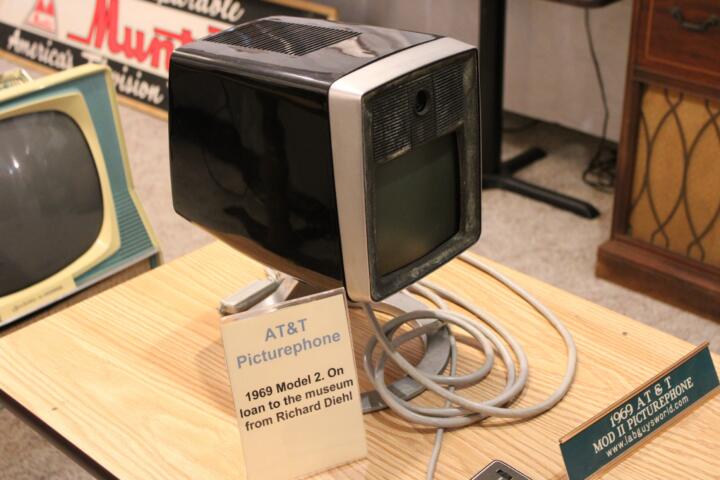
In April 1964, at the New York World’s Fair, AT&T put eight Picturephone booths inside its pavilion and let visitors call each other on them. Two months later it opened public Picturephone rooms in New York, Chicago and Washington, any two of which could be rented for a call. The rate was $16 to $27 for the first three minutes. In the following six months, 71 calls were made. The rooms stayed open until 1970 and in the final year nobody used them at all.
AT&T pressed on anyway. Commercial service opened in Pittsburgh in July 1970 at $160 a month for the equipment and the first thirty minutes. Pittsburgh peaked at 32 sets in 1972. Chicago, after a price cut, peaked at 453. The picture itself was a technical achievement: 250 lines of black and white, thirty interlaced frames a second, a camera that could be switched between the caller’s face and a document held up to it.
The failure was not in the box. A Picturephone required three pairs of twisted copper wire, two of them carrying video, and the network had been built for voice. More simply, a videophone is only useful if the person you want to call has one. Video calling arrived in the end, and it arrived over a network built for something else entirely — the internet — which is the part of the story nobody at the World’s Fair could have planned.
The robot that had to think in another room
Between 1966 and 1972, a team at Stanford Research Institute built a machine that could be told to do something and work out how. Shakey carried a television camera, a rangefinder, bumpers and a radio link. It planned routes through rooms, avoided what it found, and pushed objects around. SRI calls it the first mobile robot able to perceive and reason about its surroundings; DARPA, which funded it, notes that the 1964 proposal described capabilities that until then existed only in science fiction.
None of the thinking happened on board. Shakey’s programs ran on an SDS-940 with 64K of 24-bit words in the building, replaced later by a PDP-10, and the robot carried the results back and forth over its radio. The projects around it produced a body of technique that other laboratories then built on.
The task is now performed, in millions of homes, by a disc that bumps into a wall, maps it, and goes back to work. Nobody calls it artificial intelligence. That is what success looks like.
The hypertext the web decided not to build
Ted Nelson had the idea in 1960, chose the word hypertext in 1963 and published it in 1965. His project, Xanadu, proposed something more specific than what we got: links that run in both directions and cannot break when a document moves, quotation that points back at its source, and every version of a page kept rather than overwritten.
The web shipped the easy half. Its links go one way, they break when a page moves, and a page cannot see who has linked to it. What Nelson wanted has been partially reconstructed in wikis and version control and nowhere completely. Xanadu finally demonstrated a working version in 2014, fifty-four years after it started, as a browser demo rather than a product.
What is still ahead of us
Concorde first flew from Toulouse in March 1969. It carried passengers for 27 years at more than twice the speed of sound and up to 60,000 feet, and it stopped in 2003. Twenty were built. Nothing has carried fare-paying passengers faster than sound since, and the current attempt at a successor is still a development programme rather than an airliner.
In 1961, a barge drilled in 11,673 feet of water off Guadalupe Island, through 558 feet of sediment and 43 feet of basalt. That was Project Mohole, an attempt to reach the boundary between the crust and the mantle. Cost estimates climbed to $64 million and then $122 million, and Congress cut the funding in 1966. Mantle rock has since been recovered by drilling, but the boundary itself is still undrilled. A Chinese vessel built for the job, the Meng Xiang, is specified to drill eleven kilometres; its first scientific expeditions are expected from 2026, with full-scale drilling to the Moho planned before 2030.
And in August 1968, at a conference in Akademgorodok, Soviet researchers reported that the T-3 tokamak had held a plasma above ten million degrees for ten to twenty thousandths of a second. The best stellarator then running had never got past one million degrees, and never held it for more than a thousandth of a second. The room did not believe it; a British team went to measure it for themselves. The tokamak became the shape of nearly every large fusion experiment since. None of them has put electricity on a grid.
Ninety minutes, and the rest
The pattern is not that the 1960s were smarter than we are. A demonstration costs one laboratory and a decade costs an industry. What was missing in 1968 was never the idea. It was every unglamorous thing the idea needed in order to be cheap: wire, chips, standards, and somebody willing to pay for the middle years when nothing works and nobody claps.
Engelbart’s afternoon took ninety minutes. We are still paying for the rest of it, which is the most flattering thing that can be said about a prototype.