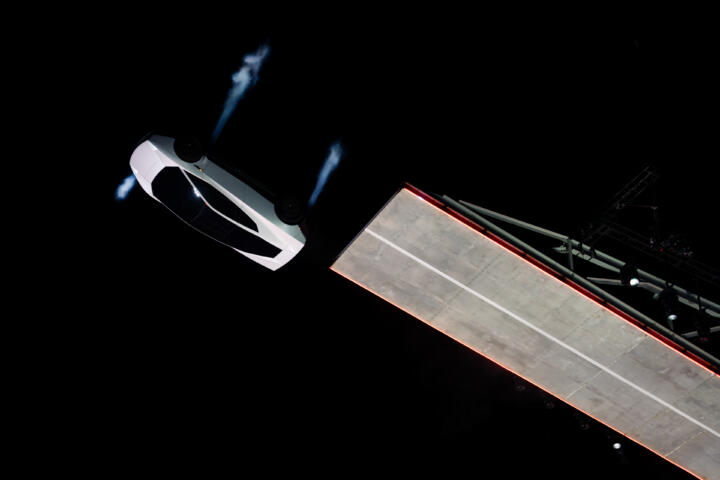
Nine years after Elon Musk first showed it, the second-generation Tesla Roadster was unveiled on 15 October 2026 — and it flew.
The reveal happened at SpaceX’s rocket development and testing facility in McGregor, Texas, rather than at a car show. That choice told you most of what you needed to know. This was not a product launch so much as a demonstration that a car company could borrow a rocket company’s hardware.
What it actually did
The two-seater launched itself over Tesla’s entire model lineup, ran from 0 to 60 mph in 0.81 seconds, then drove upside down off a high ramp, flipped over in midair and came back down to the ground, cushioning the landing with its onboard thrusters. Nobody was driving. Musk said Tesla wanted “to make sure we don’t kill anyone” during the demonstration.
It is worth being precise about the word “flying”. The car does not fly the way an aircraft flies. It hops, hovers briefly and controls its own descent. Wired described the spectacle as the Roadster doing “a big hop” and then, in Buzz Lightyear’s phrase, “falling with style.” That is a fair description, and it is also more interesting than the marketing line, because it tells you what the hardware is genuinely for.
The hardware under it
Tesla is offering three configurations — Performance, Thrust and Rocket — with the upper two using cold gas thrusters developed with SpaceX.
Four metal nozzles sit just above the rear bumper, where exhaust tips would be on a conventional supercar. They do not vent exhaust. They vent high-pressure nitrogen, stored in a large composite-overwrapped pressure vessel — a black carbon-wrapped sphere roughly the size of a gym ball, sitting behind the two front seats. Two pipes feed the four nozzles.
This is the same cold gas thruster technology used to hold a spacecraft’s attitude in orbit. On a car, its job is to hold the car’s attitude in the air, and to keep it pressed against the road when it is upside down on a ramp.
The Rocket configuration also gets a fan-based downforce system — a fan drawing air out from under the car to suck it onto the surface, the same trick Gordon Murray used on the Brabham BT46B in 1978, and the one that got that car banned.
The numbers
- Power: two rear motors producing over 1,341 hp (over 1 megawatt)
- Layout: rear-wheel drive only — a departure from Tesla’s all-wheel-drive habit
- Weight: just under 1,700 kg, barely heavier than the original 1.4-ton Roadster
- 0–60 mph: 0.81 seconds measured at the event
- Top speed: over 230 mph claimed
- Range: 310–320 miles claimed
- Production: planned for 2028, at Gigafactory Texas
- Designer: Franz von Holzhausen, who also drew the Cybertruck and the Model S
Butterfly doors, blacked-out windows during the reveal, no interior shown in detail. All the power goes to the rear wheels only, which is either a purist’s choice or a decision made for the stunt rather than the road.
Engineering
Tesla’s stock price fell after the event. The car has been “coming next year” since 2017, the production date has moved repeatedly, and the thrusters are an optional package on a car that does not yet exist in customer hands. The demonstration was real — the car did the things it did — but a stunt at a rocket facility is not the same as a vehicle you can buy.
What makes it worth writing about anyway is the engineering. Cold gas thrusters and a downforce fan are not gimmicks bolted on for a video. They are solutions to a real problem — how you keep control of a car when it leaves the ground — and nobody else in the industry is shipping them.
It flies
The Roadster started as the car that proved electric could be quick. Nine years later it is the car that proves an electric drivetrain can be pointed at problems the internal combustion era never had to solve.
Whether it flies or merely hops is almost beside the point. The interesting question is what happens when a car company stops treating gravity as a fixed constraint.
Sources: Wired, “Here’s Exactly How Tesla Made Its New 230-Mph Car Fly” · MotorTrend, “How Did the Tesla Roadster Fly? Here’s How It Works” · Wikipedia, Tesla Roadster (second generation) · CBC News and USA Today, 16 October 2026.