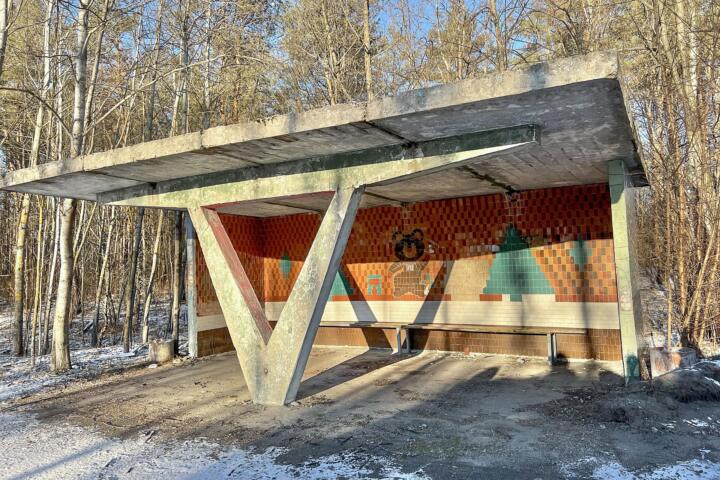
In 2013, a Californian named Dennis Keen moved to Almaty and started noticing something the people around him had stopped seeing. Soviet-era buses had long gone. The shelters built to wait in had not — and some of them were covered in mosaic.
Keen was three years old when the Soviet Union dissolved. Which is the whole explanation for why he saw it and his neighbours didn’t: he had no reason to look away.
“People notice things that are new to them,” he told The Astana Times.
What he was actually looking at
Soviet architecture was centrally supervised. Big art — monuments, façades, the things meant to stand for the state — went through committees. Bus stops did not. They were too small and too boring to matter, and that gap is where individual designers got away with something.
Christopher Herwig, the Canadian photographer who has spent two decades documenting them, calls the result “quiet acts of creativity against overwhelming state control.” He is describing hundreds of shelters scattered across the former republics, ranging from strict brutalism to outright whimsy.
Herwig found his first in 2002. Twenty years, two books and a documentary later, the project is an attempt at rescue. “The bus stops are disappearing so fast,” he says in the film. “If I come back a year from now, they could be gone, demolished, or rebuilt. These pictures may be all that’s left in the end.”
Almaty got the best of them
Between the 1970s and the early 1990s, dozens of mosaic bus stops were installed on the edges of Almaty. They are not a style of architecture so much as a form of folk art, and Keen’s project Monumental Almaty exists to keep the record of them.
He started it in 2017, and he has been doing it systematically ever since — mosaics first, then sgraffito, murals, relief sculpture and stained glass, with volunteers. It is the kind of work that looks like an archive until you notice it is really an argument: this is worth keeping, and here is the evidence.
The reason they die is not vandalism
After 1991 the organisations that maintained these shelters — collective farms, ministries, the whole apparatus — stopped existing. Nothing replaced them. The stops were left to weather, and then to construction crews.
But water kills a mosaic faster than people do. Which is why Ukraine’s first professional bus stop restoration, in the village of Sichyntsi in the Khmelnytskyi region, began with the roof.
That sequence is the whole story of conservation in one detail: before you can restore a mosaic, you have to stop the rain getting in. The SeloVDii team took the first stage last year with money raised in public, and they have been explicit that the point is not this one shelter. The point is to create a precedent.
Somebody had to relearn the technique
In Georgia the problem was worse than weather. A 1970s mosaic on a disused bus stop in Tsikhisdziri, about 65 km north of Tbilisi, was created by architect Giorgi Chakhava and artist Zurab Kapanadze. By the time the Ribirabo Foundation began work on it in late 2020, the methods used to make it had effectively been forgotten.
So the restorers studied the original tiles and manufactured new ones to match. The first stage completed in January 2022, paid for by crowdfunding. Restoring a thing can mean learning how it was possible in the first place.
Why this is a Stoked On
Because the person who ends up saving these shelters is rarely the person you would cast. Keen has not restored a single bus stop. He made it possible for one to be restored, by writing down what it was supposed to look like while it was still standing.
That is the unfashionable part of caring about objects. The rescue is boring. Ten years of photographing mosaics, of geo-tagging, of noting which panel is on which wall — that is the work. Then somebody fixes a roof, and the mosaic survives, and nobody knows whose afternoon made that possible.
The buses stopped running a long time ago. The shelters are still there, and a few of them now look better than they have in fifty years. That is worth being excited about.
Sources: The Astana Times on Dennis Keen and Monumental Almaty (2019) · Monumental Almaty mosaic bus stop survey · sovietbusstops.com and Christopher Herwig’s Soviet Bus Stops (Fuel) · Agenda.ge / DMO.GE on the Ribirabo Foundation and Tsikhisdziri (2022) · PRAGMATIKA.MEDIA on Sichyntsi and SeloVDii (2026).