Adolfo Suárez Madrid-Barajas does not announce boarding gates over the public address system. Not the gate, not a change of gate, not a final call. The airport states it plainly: you read the gate off a screen, and then you keep reading it, because nobody is going to tell you. Madrid-Barajas is a large airport that has decided silence is more efficient.
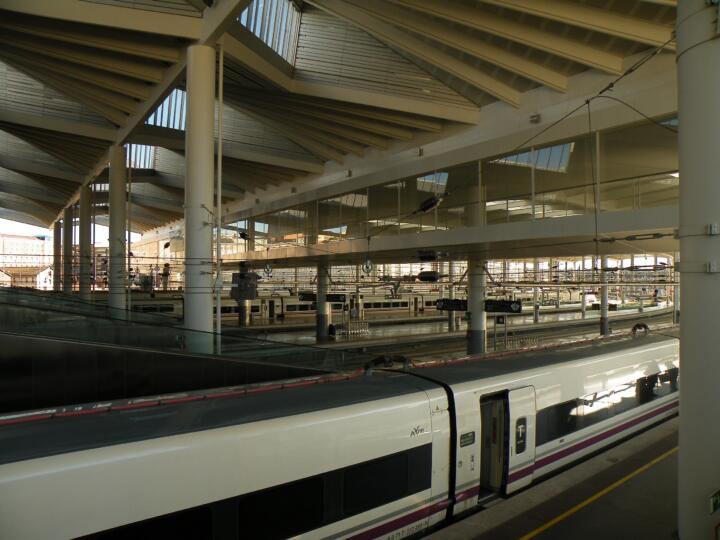
Six stops of the commuter railway away, in the middle of the city, Puerta de Atocha sends trains to Barcelona all day. The fastest non-stop covers the 620.9 kilometres of the high-speed line in two hours and thirty minutes, city centre to city centre, and the fare includes the commuter ride at either end.
The aeroplane is not the slower machine. Everything around the aeroplane is slower, and it can be counted.
Two timetables, and only one of them is on the ticket
The number a ticket advertises is the time in transit: two and a half hours for the train, roughly eighty-five minutes for the flight. Those two numbers are the entire basis of the argument that flying is faster, and they describe about a third of the trip.
The number that decides your day is the time from a doorway in Madrid to a doorway in Barcelona. That one includes the metro, the queue, the walk to a gate, the wait, and the fact that a plane lands at an airport outside the city it is named after.
On the rail side the published times are almost boring. The fastest non-stop runs Atocha to Sants in two hours thirty; the average across all the operators is around two hours forty-two; and the cheap trains take three hours or a little more, because they stop in Zaragoza and Tarragona. Ouigo’s own published timetable for the corridor shows direct services at three hours and two minutes, with fares from nine euros.
On the air side the transit time is real and the rest is not on the ticket.
What the airport asks of you
Barajas puts its high-speed trains underground. Metro line 8 runs from Nuevos Ministerios in the north of the city to Terminal 4, and Aena’s own figures put that ride at eighteen minutes. Terminal 4 is where Iberia checks in.
Then the airline sets its terms. Iberia asks passengers to be at the airport two and a half hours before departure for every destination that is not the United States, Canada or Latin America. Check-in closes forty-five minutes before the flight. Boarding closes twenty minutes before. Those are not suggestions; they are cut-offs after which the airline says it has no liability.
At the other end the geography gets worse. Iberia operates from Terminal 1 at El Prat. The commuter line, the R2 North, only reaches Terminal 2. So the last leg of a flight to Barcelona is a free shuttle bus between terminals — fourteen minutes, every five to seven minutes, twenty-four hours a day — followed by the R2 North itself, which runs to Sants roughly every half hour in about twenty minutes.
That is the part nobody puts in the fare comparison: an airport transfer, a shuttle bus, a timetable with a thirty-minute headway, and a walk at each end.
What the station asks of you
Atocha asks for less. There is a bag scanner at the entrance to the high-speed area, and Spanish practice is to be there twenty or thirty minutes before departure. Renfe’s own guidance is blunt about the hard limit: access control closes five minutes before the train leaves.
No bag drop. No weight queue. No liquids rule. A suitcase is a piece of luggage you roll, not a transaction. Sants, when you arrive, is a metro stop and a commuter station as well as a terminus, and it is open from half past four in the morning until a quarter past midnight. The ticket also includes a free Cercanías journey at either end, which is the only airline-style perk in the comparison that runs the other way.
The ledger
Add it up honestly, with hand luggage and a boarding pass on a phone. Published times where published, estimates clearly labelled.
| Leg | Train (AVE, non-stop) | Plane (Iberia, T4 to T1) |
|---|---|---|
| Centre to the departure point | 10 min to Atocha (est.) | 28 min to T4: commuter to Nuevos Ministerios, then 18 min on line 8 |
| Terminal or station, bag scan, walk | 15 min (est.) | 40 min (est.) |
| Buffer before departure | 20 min | 90 min; 150 if you follow Iberia’s own advice |
| In transit | 2 h 30 | 1 h 25 |
| On arrival | 5 min | 15 min, then 14 min shuttle T1 to T2 (+ wait) |
| Airport or station to the centre | 10 min (est.) | 35 min: R2 North plus the average wait |
| Door to door | 3 h 25 | 5 h 23 |
The flight spends eighty-five minutes in the air. Everything around it spends close to four hours. The train spends two and a half hours moving and fifty-five minutes doing the rest, and it starts and ends inside the two cities.
That is a two-hour gap on a route where the aeroplane is supposed to be the fast option, and it widens to nearly three if you take the airline at its word and arrive two and a half hours early.
What happened when the train got quick
The line opened on 20 February 2008 for an investment of more than 8.9 billion euros, and the first train took two hours thirty-eight. RTVE, fifteen years on, records what followed: rail’s share of the Madrid-Barcelona market went from under 40% at the start to 75.8%, on 54 daily circulations and 140 million passengers.
Catalan News, marking the same anniversary, puts the crossover in 2012, share steady around 60% for the rest of that decade, and 4.3 million rail passengers against 2.5 million by air in 2019.
Then the fares fell. Avlo and Ouigo arrived in 2021 and Iryo at the end of 2022, which made Spain the first European country with three operators on one high-speed corridor. Catalan News estimated that the railway carried roughly three times the passengers of the aeroplane on the same pair of cities over the first nine months of 2022.
Where the plane is still right
Two honest exceptions. The first is connection: if Barcelona is a stop on the way to somewhere else, a train to Sants is no use to you, and Barajas is a hub in a way that Atocha is not. The second is that El Prat has no high-speed station at all — the R2 crawls into Terminal 2 while the AVE tracks pass within reach of the airport. That gap is exactly why the air bridge survives at all, as the transport researcher Joan Carles Salmerón told Catalan News.
There is also a distance limit. Six hundred kilometres is where the arithmetic is most favourable to rail, and it gets less favourable going east to Valencia or south to Seville, and reverses somewhere past a thousand.
If you are going
Book with Renfe, Ouigo or Iryo, and read the duration on the specific departure rather than the headline. Nine euros buys a seat, not the fastest one: the two-hour-thirty services are the non-stops, and the cheap timetable is a three-hour timetable with stops.
The first train leaves Atocha at 06:20. Take a non-stop and you are in Sants before nine, in a city where the station is on the metro map and the coffee is already open. The alternative leaves from an airport that will not call your flight.
Sources: Aena (Madrid-Barajas departures area, Metro line 8 access, El Prat terminals and inter-terminal shuttle) · Iberia (check-in cut-off times) · Renfe (Madrid-Barcelona route, Cercanías combination, access control rules) · Rodalies de Catalunya (R2 line frequencies) · Ouigo Spain (published Madrid-Barcelona timetable and fares) · RTVE and Catalan News on fifteen years of the AVE · Wikipedia on the Madrid-Barcelona high-speed line.